


Goodbye Grass: Native Groundcover Stars to Transform Your Turf + Tips to Get Started

Updated: May 6
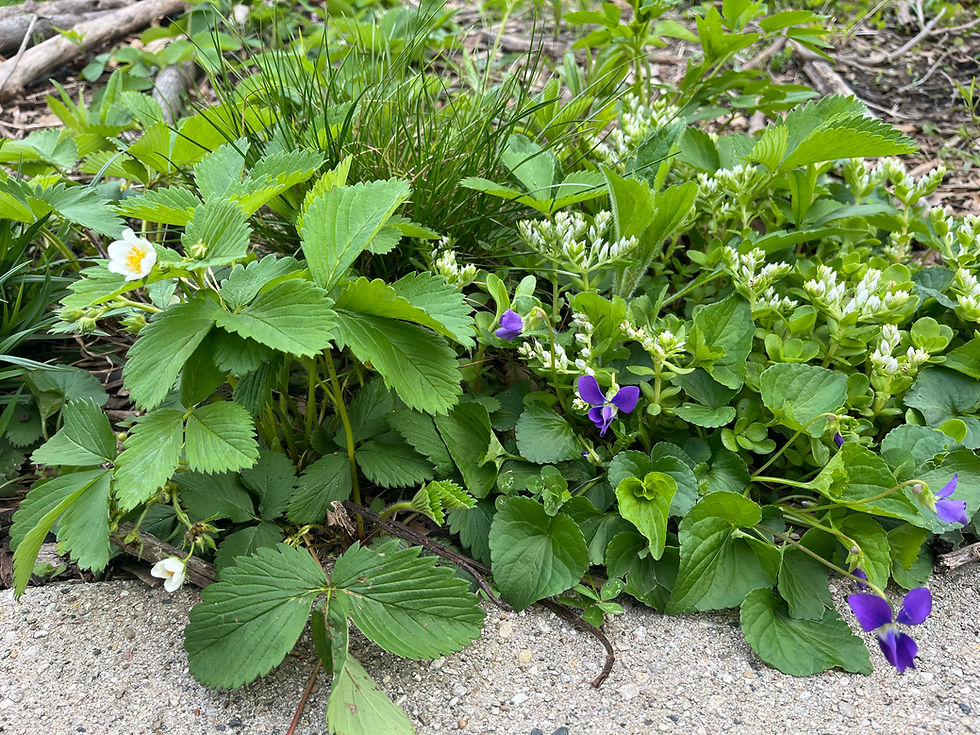
Native groundcovers are often described as “weed-suppressing,” but it’s worth clarifying what that actually looks like in practice. No planting can eliminate weeds entirely. Instead, a well-designed native planting reduces weed pressure over time by doing three key things: filling space, competing for light and nutrients, and shading the soil so fewer weed seeds can germinate.
The goal isn’t a perfectly weed-free yard. It’s a balanced, living plant community that largely takes care of itself.
That transformation doesn’t have to happen all at once. In fact, the most successful native landscapes are often built gradually. Start with one section of your landscape, observe how it changes, and expand over time. Even a small patch of native groundcover adds beauty, supports pollinators, and begins shifting your yard toward a more resilient system. You can keep editing, adding, and refining until it feels right to you. So, here are some steps to get you started:
Step 1: Site Prep (No. 1 for a reason)
Most of your future weed control happens before you plant a single plug. Skipping or rushing this step almost always leads to more work later.
Remove all existing vegetation, including turfgrass, weeds, and as much root material as possible
Pay special attention to perennial weeds and creeping species—dig out the full root system to prevent regrowth
Rake and smooth the soil surface so it’s level and ready for planting
By clearing the space fully at the start, you give your native plants a real advantage during establishment.

Step 2: Plant a Dense “living matrix”
Think less about individual plants and more about how they function together as a community. A dense, layered planting (sometimes called a ‘living matrix’) is the foundation of a low-maintenance yard.
Plant closely to minimize bare soil
Mix species to occupy different ecological niches
Match plants carefully to light and moisture conditions
Dense plantings leave fewer opportunities for weeds to take hold. Just as importantly, they look more natural. Instead of spacing plants evenly like a grid, try grouping them in clusters of three or more and weaving different species together. This creates a more organic, meadow-like feel while still allowing each plant to establish.
Step 3: Stewardship (first month = critical)
The first few weeks after planting are when your groundcover either succeeds or struggles.
Water deeply once per week to encourage roots to grow downward
Allow the soil surface to dry between waterings to prevent shallow rooting
Weed early and often, before unwanted plants become established
Watch for signs of stress and adjust watering or planting density as needed
Early attention pays off. Once your plants are established, they begin to do the work of weed suppression for you.
Some Groundcover Combos to Try
Below are combinations of native species that work together to form a layered, weed-resistant groundcover. These are not rigid recipes, but starting points you can adapt to your site.

Polemonium reptans (Credit: Meneerke bloem) 
Carex blanda (Credit: Alison Northup) 
Viola sororia (Credit: Bernt Fransson) 
Asarum canadense (Credit: Michael Wolf) 
Tiarella cordifolia


Woodland (shade to part-shade)
Polemonium reptans (Jacob’s ladder) — a clumping early blooming species that will brighten your shade garden
Carex blanda (woodland sedge) — dense, fibrous roots that stabilize soil and suppress weeds
Viola sororia (common violet) — fills gaps quickly and tolerates a range of conditions
Asarum canadense (wild ginger) — broad leaves that effectively shade the soil surface
Tiarella cordifolia (foamflower) — clumping, slowly spreading, adds seasonal texture
Together, these species create a soft, continuous carpet that thrives under trees and along north-facing foundations.

Packera aurea (Credit: Choosenativeplants) 
Geranium maculatum (Credit: H. Zell) Carex rosea 
Aquilegia canadensis (Credit: Ayotte, Gilles, 1948) 
Mitchella repens {Credit: jillllybean)
.jpg#/media/File:Golden_Ragwort_(Packera_aurea).jpg)


.jpg#/media/File:Mitchella_repens_(16149356909).jpg)
Savanna (part-sun)
These conditions allow for a bit more vertical layering, with a mix of groundcovers and light seasonal structure.
Packera aurea (golden ragwort) — semi-evergreen and spreading, excellent for early-season coverage
Geranium maculatum (wild geranium) — provides a spring canopy, then opens space for lower growers
Carex rosea (rosy sedge) — fine-textured and adaptable, filling in between larger plants
Aquilegia canadensis (wild columbine) — airy, short-lived perennial that self-seeds gently
Mitchella repens (partridgeberry) — a true low groundcover, creeping along the soil surface
This mix balances structure and softness, with enough density to suppress weeds while still feeling light and dynamic.

Geum triflorum (Credit: NPS/Diane Renkin - NPGallery) Carex meadii (Credit: Will Van Hemessen) 
Juncus tenuis (Credit: illinoiswildflowers.info) 
Antennaria neglecta (Credit: El Grafo) 
Viola pedatifida (Credit: Derek S. Anderson)
.jpg#/media/File:Prairie_Smoke_-_Geum_triflorum_(bac24c04-5d1b-4bbd-a657-f44ec1ef8682).jpg)
.jpg#/media/File:Antennaria_neglecta_%C3%96BG_2012-05-20_01_(2x3).jpg)
Prairie (full-sun)
Sunny sites are ideal for dense, prairie-inspired groundcovers that combine grasses-like textures and low growing forbs.
Geum triflorum (prairie smoke) — compact and drought-tolerant, with unique seasonal interest
Carex meadii (Mead’s stiff sedge) — a reliable matrix plant that fills soil gaps
Juncus tenuis (path rush) — thrives in compacted or disturbed soils where other plants struggle
Antennaria neglecta (field pussytoes) — dense, spreading mats that hug the ground
Viola pedatifida (prairie violet) — fills in between species and adds early color
These species work together to create a sun-loving planting that is both tough and visually vibrant, especially once established.
👏🐝
Replacing even a portion of your lawn with native groundcovers is an easy way to make a huge impact in your landscape. What starts as a small patch quickly becomes something more alive and buzzing with pollinators, shifting with the seasons, and rooting itself into place year after year.
This is a different kind of beauty than a traditional lawn. It’s softer, more dynamic, and far more rewarding to watch unfold. And the best part is, it keeps getting better with time.
Start small. Plant densely. Stay attentive early on. Then step back and watch your yard come to life!

North Branch Natives is a home-grown, sustainable Chicago business offering gardening solutions and support for DIY native gardeners.


Comments